Email us at [email protected]
Your child should be talking by now.
This is what finally worked for us.
My son didn’t speak until he was almost five.
And just a few weeks after starting this method, he said his first sentence.
This is him about 8-9 months into this method. And nothing was working until that.
I spent over $6,000 and traveled across the world to learn this method. When we came home I turned it into a simple video course and priced it so any family could afford it.
You are about to learn a simple, science-backed method for kids with speech delays used for decades in Europe. And nobody talks about it in the US.
❗From mumbling to telling a full story — watch the change in 42 seconds.
We spent years in speech therapy with no progress. By age 4.5, he still couldn’t repeat a single word on his own, other than a handful of simple, one-syllable words, like 'please', 'help', 'bye'. Within just a few months of starting this program he began speaking in two languages. Not perfectly of course - he was still behind his peers. But now we’re finally able to work on improving his speech (in two languages!) instead of constantly wondering if he will ever speak at all.
Before
We spent years in speech therapy with no progress. By age 4.5, he still couldn’t repeat a single sentence on his own . His vocabulary was limited to a handful of simple, one-syllable words, like 'please', 'help', 'bye'.
After a few months
Within just a few months of starting this program he began speaking in two languages. Not perfectly of course - he was still behind his peers. But now we’re finally able to work on improving his speech (in both languages!) instead of constantly wondering if he will ever speak at all.
OUR STORY

Hi, I’m Elya. I’m a mom and an educator. I’ve been teaching for years, but this is the most valuable thing I’ve ever shared, because it changed my son’s life.
When he was four and a half, he couldn’t say more than few short words like “hi,” “bye,” “help,” or “hummy” instead of “hungry.” In Russian, his second language, he couldn't say anything.
We started seeing specialists when he turned 2. He had an IEP, he went to speech therapy, countless tests. Nothing was working. It looked like he couldn't control his mouth, it was impossible for him to put sounds into words. All the professionals said he would catch up. Of course, we trusted them, and continued following their suggestions, waiting and praying.
But after years without any progress I realized nobody really cares about my child as much as I do. I was terrified to imagine the struggles he would go through as he got older—even at that age (3-4), kids had already started avoiding him after hearing him "speak".
Then (when my son was 4.5) we discovered this method while visiting family in Russia. And within several months he was finally able to communicate in both languages (but he said his first sentence within weeks of starting the program).
Was he still behind? Yes. But compared to before, it was night and day. And my biggest regret is that we didn’t start sooner.
And it’s not just our story. At the child development center where we discovered this, they use this method with every child who has delays (autism, speech disorder, learning disabilities, etc.) . They call it the foundation of brain development.
Like I said, all that happened while we were visiting family in Russia. I was blown away by the effect of this method and I didn't want my son to stop doing the exercises. But we had to go back home to the U.S. and I knew there was nothing like it here. So I studied the method, read books, watched videos. And I attended each session watching, asking questions, learning, practicing.
After returning to the states I continued helping my son with the exercises, and he continued to improve. So much so that I felt compelled to create a video course that teaches other parents exactly what I learned. I call it The Gap Jump program.
The science behind this method is complex but the method itself is SOOOO simple! You can start at home today. All you need is a soft surface (about 10 feet) and 20-30 minutes a day.
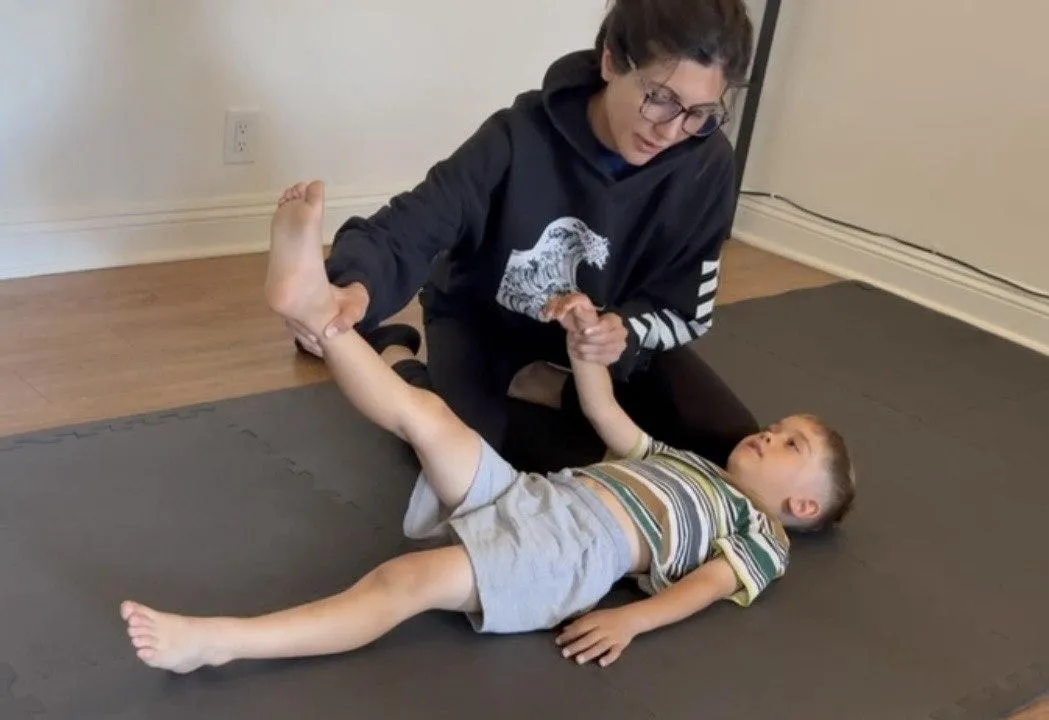
The Gap Jump Method helps your child “catch up” on key developmental steps their brain needs for speech and learning — through a series of 15 core movements and multiple variations. It is designed for children 3-10 years old.

*an example of one of the exercises
The work of pioneering neuropsychologist Alexander Luria is the foundation of today’s theory of neuroplasticity. Neuroplasticity is the brain’s ability to rewire itself. He had remarkable success rehabilitating WWII soldiers who suffered traumatic brain injuries.
Luria's research showed how the brain can rebuild its functions through targeted training, even years after an injury. Later modern neuropsychologists turned this breakthrough into powerful methods that help children overcome developmental delays.
When a child doesn’t speak, it often means the brain’s wiring didn’t form when it should have — usually in the first year of life. Speech requires both sides of the brain to work together smoothly, connected by a “bridge” called the corpus callosum. When this coordination is disrupted, speech delays and other symptoms appear.
The good news is the brain can still build these connections with proper training.
The Gap Jump method helps your child “replay” the critical developmental stages they missed using physical movement to re-activate brain areas that didn’t get properly wired, and to strengthen the communication between the two sides of the brain.
Once your child is able to complete all the exercises correctly and with ease, the program is finished - and the missing neural connections have been formed.
How It Works
The moment you enroll, you'll get access to our online portal (from your phone or desktop), and it's yours for life. Inside you'll find 15 video lessons (+2 intro lessons) — the exact exercises my son and I did, filmed as we were doing them. Each one is 2–6 minutes, with written directions underneath so you're never guessing.
Most parents watch from their phone, right there on the floor next to their child.
You'll watch my son struggle with certain exercises. I left it that way on purpose, to show you that it's normal. I could have shown you a kid performing every movement perfectly — I didn't, because when he first started, he couldn't do anything. And I mean ANYTHING. Every movement was hard for his brain to coordinate.
And now he talks — and he can do all of them.
✅ 15 simple core exercises with variations
✅ No special equipment
✅ No therapy bills
✅ Just 20-30 minutes on a soft floor with your child 3–5 days/week (consistency is key)
If your child:
Isn’t speaking (or speaks very little)
Struggles to focus or learn
Has been through speech therapy with little or no progress
Or you just feel something’s “off” and no one has answers...
This is for you.
I built it for families like mine.
Here's the hard part no one tells you: the brain is most ready to build these connections when your child is young — and every month of waiting makes the gap a little wider, and the catching-up a little harder. That's not meant to scare you. It's the one thing I wish someone had told me sooner. Starting today is always better than starting later.
What other parents say:
I’m not a therapist. I’m just a mom.
But I watched this method help my son go from silence… to sentences.
And I’d love for you to have that chance, too.
Start Helping Your Child Speak Today
Get full life-time access to The Gap Jump Method
with a special one-time discount 60% OFF
Start helping your kid for only $497 $197
This deal will expire in...
*15 step-by-step video lessons.
One simple routine. 20 minutes a day. The goal: your child's first sentence.
🔒 Secure Checkout | ✅ Lifetime Access | 📧 Personal Support
⚠️Just a heads up — with ad costs rising, the price will likely go up soon.
SORRY... the 60% Off deal has expired.
But you can still get 50% off if you enroll now
50% OFF One-time deal
Start helping your kid for only $497 $249
This deal will expire in...
*15 step-by-step video lessons.
One simple routine. 20 minutes a day. The goal: your child's first sentence.
🔒 Secure Checkout | ✅ Lifetime Access | 📧 Personal Support
⚠️Just a heads up — with ad costs rising, the price will likely go up soon.
SORRY... this deal has expired.
But you can still buy this program for just $497
Start helping your kid for only $497
*15 step-by-step video lessons.
One simple routine. 20 minutes a day. The goal: your child's first sentence.
🔒 Secure Checkout | ✅ Lifetime Access | 📧 Personal Support
⚠️Just a heads up — with ad costs rising, the price will likely go up soon.
After the purchase, you'll receive an automated email with your log-in credentials. If you don't see it, please check your Junk folder. If you have any trouble accessing the course, email us at [email protected]
(I reply to all emails personally during my work breaks, so it may take me a couple of hours to respond.)
A clip from one of our sessions in Russia
FAQ:
Does this replace speech therapy?
The Gap Jump Method works with speech therapy, not instead of it. Think of speech therapy as learning how to drive a car — The Gap Jump Method is like turning on the engine first.
It helps the brain “click” and become more ready to use external signals in the right way. From there, speech therapy and everyday life — reading, speaking, learning — can build communication on top of that foundation.
Why invest in the Gap Jump Method?
When I first started seeing results from this method, I was obviously excited. But I was very upset that I didn't learn about this sooner. The science behind these exercises made so much sense to me that I couldn’t believe how unfamiliar this approach was in the U.S.
All we did were 15 exercises (with variations). And once I understood what to do, I was able to do everything at home with my son by myself. That’s how simple it is.
Since creating this program, I’ve connected with parents who signed up and shared some of the methods they were offered here in the U.S. I now see that similar approaches do exist — but they often cost thousands of dollars, which many families simply can’t afford.
That’s why I priced The Gap Jump Method as a one-time purchase you own for life. It gives you tools you can use every day, anytime, with no ongoing costs. Parents often tell me it’s the best investment they’ve made for their child’s communication.
How can the physical exercises trigger speech?
It sounds surprising, but speech doesn't start in the mouth — it starts in the brain. And the brain builds the wiring for speech through movement first. Think about it: every baby crawls, rolls, and reaches long before their first words. Those early movements aren't random — they're how the two sides of the brain learn to work together, which is exactly what speech requires.
When some of those movement stages get skipped or rushed, the connections speech depends on may not fully form — and that's often when delays appear. The Gap Jump exercises guide your child back through those missed patterns, letting the brain "replay" the steps it didn't finish. Thanks to neuroplasticity (the brain's ability to rewire itself), those connections can still be built. Once they are, speech finally has something to grow from.
Do I need special training to do this?
Not at all! The science behind it is complex, but the exercises are simple and natural - any parent can help their child do them at home. It works even better when you do it with your child, because it becomes fun time together.
My course includes step-by-step videos (with my son) plus clear directions, so you’ll never feel lost. And if you do - you can always ask your question by emailing [email protected]
How often do we need to do the exercises?
You’ll want to do the exercises at least 3 times per week, for 20–40 minutes per session (depending on how long your child is comfortable). The important thing is to keep it enjoyable, don’t push too hard. Turn it into a game, add some fun, and even give small rewards afterwards if you’d like.
Consistency is key. Some families prefer longer sessions a few times a week, while others do 3–4 exercises each day. Both approaches work — choose what fits your child best.
Most exercises come with several variations, and it’s important to practice them all. The ultimate goal is for your child to complete every exercise and variation with ease. When that happens, it’s a strong sign that the missing neural connections have been formed.
P.S. It’s completely normal if your child resists at first. Once it becomes part of the routine, it usually gets much easier.
When will I see results?
Most parents begin to see measurable changes within about 2 months. Every child is different, and in some cases it may take longer — consistency matters most.
In our case, my son said his first full sentence in about 3 weeks (we did the full set of exercises daily). That experience showed me how powerful this approach can be, but it’s important not to compare timelines.
If progress feels slow at first, don’t get discouraged — staying consistent is key (I know, I keep saying that, but this IS key). Some parents continue using the program even after speech goals are met, because they find it to be a great activity for their child’s physical and mental well-being.
Is it safe for my child?
Yes. The Gap Jump Method is designed to be safe. It consists of 15 simple, natural body movements that children can do on a soft surface at home. No equipment is needed — just a little space (about 10–12 feet).
The exercises are structured in a specific way to gently stimulate the brain and support the formation of new neural connections. As with anything involving your child’s health, we always recommend consulting your doctor if you have any concerns.
Can this help a child with autism?
Autism is a very broad spectrum, and every child is different — which is exactly why so many parents of autistic kids feel stuck with one-size-fits-all advice that never quite fits.
Here's what's important about this method: it isn't a "treatment" for any one diagnosis. It's built on natural, fundamental movements — the same developmental stages every child's brain is designed to move through in the early years. At the center where we learned it, they use it with every child who has delays — autism, speech disorders, learning difficulties — as long as the child can do the movements. Because it works at the foundation, helping the brain "catch up" on the steps it may have missed.
And that foundation is why parents so often see more than they came for. We started because of speech — but the real surprise was everything around it: my son's focus, his awareness, his ability to handle things that used to overwhelm him. It wasn't just that he started talking. It's that his whole world seemed to open up.
If your child is on the spectrum and can do the movements, there's every reason to try — it's gentle, it's natural, and you can start at home today. (As always, check with your doctor if you have any concerns.)
Did your son take any supplements or do any detox program?
No. My son did not take any supplements or vitamins (other than regular vitamin D), and we did not do any detox programs.
I want to be clear about this because I get asked often.
I don’t have a strong opinion for or against supplements or detoxes - I can see how those approaches could help. And honestly, if we were still searching for answers, I would be open to trying different things, including something like that.
I’ve spoken to parents who signed up for my course after trying supplements or detox programs and didn’t see the progress they were hoping for. That doesn’t mean those approaches don’t work in general. Every child is different, and I believe we should always keep looking for the right approach that helps our children. For us, that approach was The Gap Jump Method.
What parents say about The Gap Jump exercises:
"I’ve been told that boys develop slower, so I shouldn’t worry about my son’s speech delay just yet. We did standard speech therapy at a local place here in Miami, but it felt like they were just babysitting my kid with some playtime. So I started doing activities with him at home such as role-playing, tongue exercises, etc. Then I saw an ad for Gap Jump and decided to add it to our home routine. It made such a difference! My son is 3 now, and not only has he started really trying to speak, but I can see his overall thinking process has reached a new level (for example, he does puzzles now). Highly recommend!"
Gabriella N. (son, 3y.o.)
The Gap Jump program is what worked for us. My daughter had a speech delay. Now she can speak. She does the Gap Jump exercises daily.
Rob S. (daughter, 5 y.o.)
We signed up for the Gap Jump program a few months ago. I got curious because of the science behind this method. I’m a huge believer that the brain can be rewired with the proper work. We do the exercises 2–3 times a week, and this week my kid said, “I don’t want blololi” (he meant “broccoli”). Imagine my face at that moment... I almost cried. I immediately emailed Elya to share our win, and now I’m writing this review. I hope it helps spread the word about this method.
Stormy K. (son, 4 y.o.)
Great exercises!!! If your child is struggling with speaking, DO NOT wait!! Time is working against you! These exercises are fun and really work! I'm so grateful I found this!